You can respond to a negative review, but only with a short, calm reply that reveals nothing about the client or the matter. Confidentiality is the limit, and a bad review does not lift it. This post covers what the rules allow, a simple decision flow, reply templates, and how to get a review removed.
This is general information, not legal advice. Rules differ by state, so check your own state bar before you post. The examples here come from North Carolina’s ethics opinion and a handful of other jurisdictions.
Why can’t you just defend yourself?
Rule 1.6 protects client information even after the client attacks you in public. The ABA’s Model Rule 1.6 and its state versions bar a lawyer from revealing client information unless an exception applies. North Carolina’s Rule 1.6 has a self-defense exception, but it covers a “controversy between the lawyer and the client”, a defense to a claim, or a response in a proceeding about your work.
Take a fictional three-lawyer injury firm in Phoenix that gets a one-star review from a former client claiming the firm ignored their calls. Its lawyers may be certain the claim is wrong, and the file may prove it. Posting those facts in reply is still the risky move.
What do the ethics opinions say?
Several opinions agree: you may reply, but only in a restrained way, and a review alone does not trigger self-defense. North Carolina’s 2020 Formal Ethics Opinion 1, adopted in July 2021, says a lawyer may post “a professional and restrained response that does not reveal any confidential information”. It also says a review is not a “controversy between the lawyer and the client” under the exception.
An ABA Journal article from June 2020 describes the same approach elsewhere. It cites Los Angeles County Bar Opinion 525, which allows a reply that is “proportionate and restrained”, and says San Francisco, Texas, Colorado, Florida and Pennsylvania have taken similar positions. The same article lists discipline for lawyers who posted client names, fees and personal details in reply.
Two things the opinions leave open: how much detail counts as too much, and what you may do on platforms other than review sites. When unsure, say less.
Who left the review?
Who wrote it decides what you may say. The NC opinion treats these cases differently:
| Reviewer | What you may say |
|---|---|
| Former client | Brief, restrained reply |
| Never a client | That you never represented them |
| Declined prospective client | Don’t confirm or deny |
The third row catches people out. If the reviewer talked to you about a case and may count as a prospective client under Rule 1.18, the opinion says you may not confirm or deny the representation. You may say that you cannot take every case and list general reasons for declining.
How do you decide whether to reply, flag or ignore?
Wait a day, then work through four questions. A Vermont bar counsel quoted by the ABA Journal says not replying carries no ethical risk, so silence is a legitimate choice.
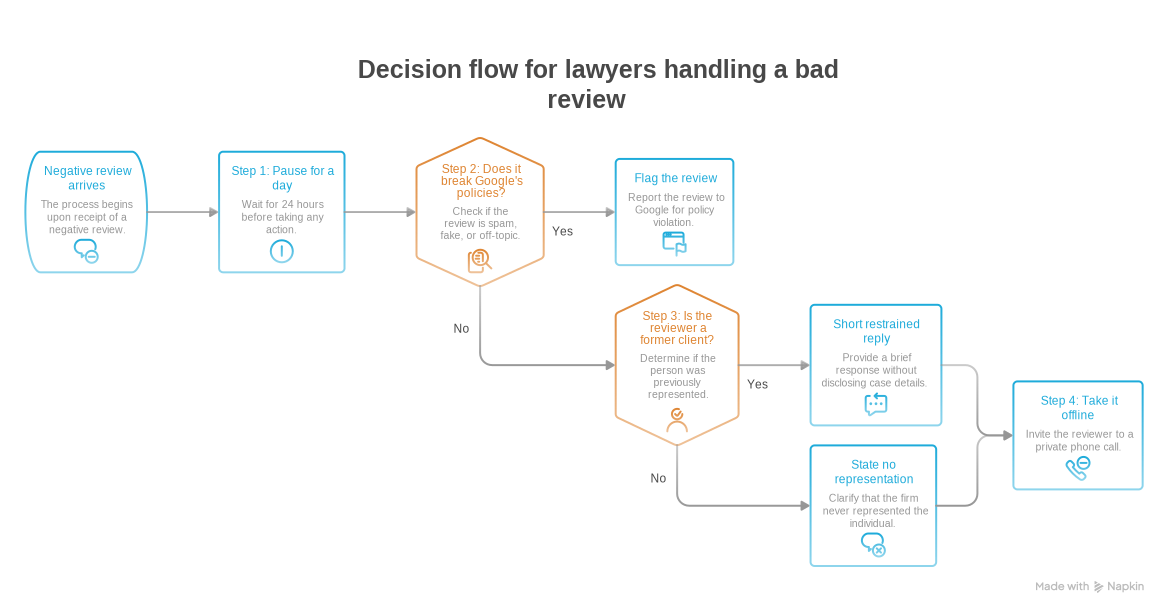
- Does it break Google’s rules? Spam, a fake review or off-topic content can be flagged. A review you simply dislike cannot.
- Is the reviewer a former client? Reply briefly with no case facts.
- Is the reviewer not a client? You may say you never represented them, unless they talked to you about a case as a possible client. Then neither confirm nor deny, and invite a call.
- Is it a fair complaint? Reply, and ask them to call. Fix the process if the complaint has a point.
What does a safe reply look like?
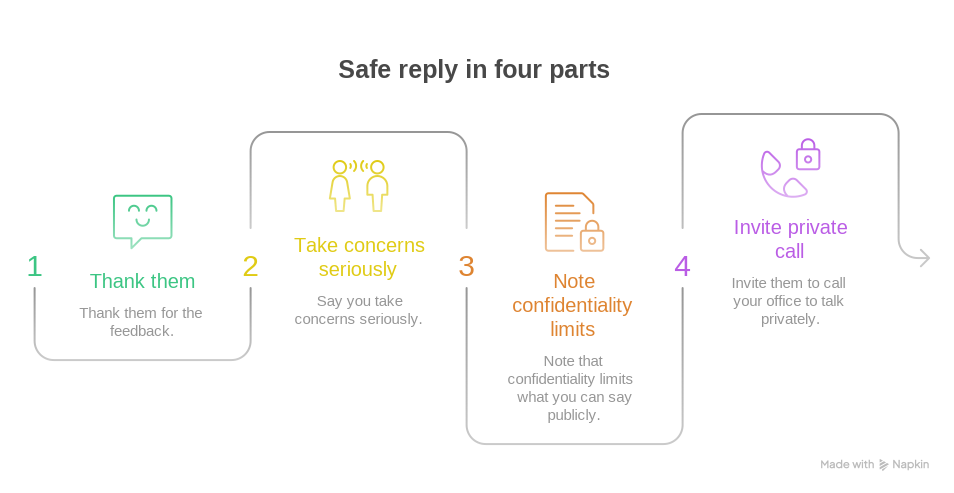
A safe reply thanks the reviewer, shows you listened, and moves the conversation offline. It never mentions the matter. Here is a template for a former client:
“Thank you for the feedback. We take every concern seriously. Confidentiality rules limit what we can say publicly, but we’d welcome a call to hear more. Please contact our office at [phone].”
Where the reviewer never spoke to you about a case:
“We have no record of representing you, so we can’t speak to this experience. If you’d like to tell us more, please call [phone].”
North Carolina’s opinion allows saying you never represented a non-client, and other states may be stricter, so check yours first.
What should you never write?
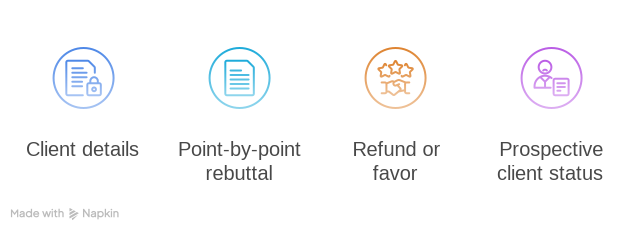
Never argue the facts, even when you are right. Four mistakes come up again and again:
- Naming the client, the matter, the fee or the outcome.
- Rebutting the review point by point.
- Offering a refund or favor if the reviewer changes or deletes the review. The NC opinion says there can be no quid pro quo for a revised or withdrawn review, and Model Rule 7.2(b) bars giving anything of value for recommending your services.
- Writing a clause into your engagement letter that permits disclosure if the client posts criticism. The NC opinion says that does not give adequate information for informed consent.
How do you get a review removed?
Only reviews that break Google’s policies come down. Google’s help page on reporting reviews says you can flag a review in your Business Profile by choosing Read reviews, then Report. Google warns against reporting a review because you disagree with it, and says it does not step into disputes between a business and its customers.
Evaluation usually takes several days. If Google finds no violation, you can submit a one-time appeal through its Reviews Management Tool. Don’t count on removal, since a plain complaint from a real client will usually stay.
If the review contains a false statement that harms you, the NC opinion allows a defamation claim where there is a basis in law and fact, with disclosure only of what is reasonably necessary. Make that decision with your own counsel, not in the reply box.
Can I reveal client information to defend myself?
Not in a review reply. The self-defense exception in Rule 1.6 is for a controversy, a claim or a proceeding, and the NC opinion says a negative review alone does not meet that bar. The opinion points to a manifestation of intent to start proceedings as the trigger. It doesn’t say what counts as enough, so ask your state bar before relying on the exception.
If a fee dispute or malpractice claim really exists, disclosure is limited to what is reasonably necessary, and Rule 1.6 comment 16 says the exception permits disclosure but never requires it. Choosing not to disclose does not violate the rule.
What does a bad reply look like?
A bad reply sounds like a closing argument. Back to the fictional Phoenix firm: imagine its managing partner replies, “Mr. Doe missed three appointments and rejected a fair offer, so the delay was his fault.” That one sentence discloses the matter, argues the facts and names the client. The ABA Journal article lists discipline for lawyers who revealed similar details in public replies, and a reply like this would also read badly to every prospective client who sees it.
The calm template above shows readers that the firm listens and protects its clients’ secrets.
How do you prevent the next one?
A steady flow of honest positive reviews puts one bad review in context. A prospective client reads the average and a few recent reviews, not one angry post. Our guide to getting more Google reviews covers the ask, the timing and the bar rules.
Prevention also means fixing the cause. Complaints about unreturned calls, unclear fees and missing updates are the ones you can fix. I’d start with a regular status email to clients. Reviews also sit on your Google profile, part of local search.
Where to start
- Write your two reply templates now, and have them checked against your state bar’s guidance.
- Pause 24 hours before replying to any negative review, then use the decision flow above.
- Keep asking happy clients for reviews, so one bad review sits among many good ones.
If you’d rather hand off review monitoring and your local presence, that is part of our law firm SEO work.