A strong attorney bio page tells a worried stranger, in the first two sentences, who you help, with what kind of problem, and why they can trust you. Then it backs that up with plain facts and gives them one easy way to reach you. This post covers what to put on the page, a section-by-section template with a before and after, the bar rules on claims, and the layout details that help it show up in search.
Why does your bio page matter so much?
People hire a lawyer, not a website, so your bio is where they decide whether to call. Practice pages answer “can this firm handle my problem?” The bio answers the harder question: “do I want this person on my side?”
A GPSolo article from the ABA describes the basics of a firm site as an online business card, with the attorney photo, awards and practice summaries adding familiarity and depth (ABA GPSolo). The bio is where all of that comes together for one person.
Take a fictional two-lawyer family law firm in Columbus. A parent going through a custody dispute lands on its site from a search, reads the practice page, then opens both bios. My bet is on the bio that sounds like someone who understands their situation. Yet many firms write that page once and never touch it again.
What should be in an attorney bio?
Lead with the client’s problem, then prove you can handle it, then make contact easy. Everything else is supporting detail.
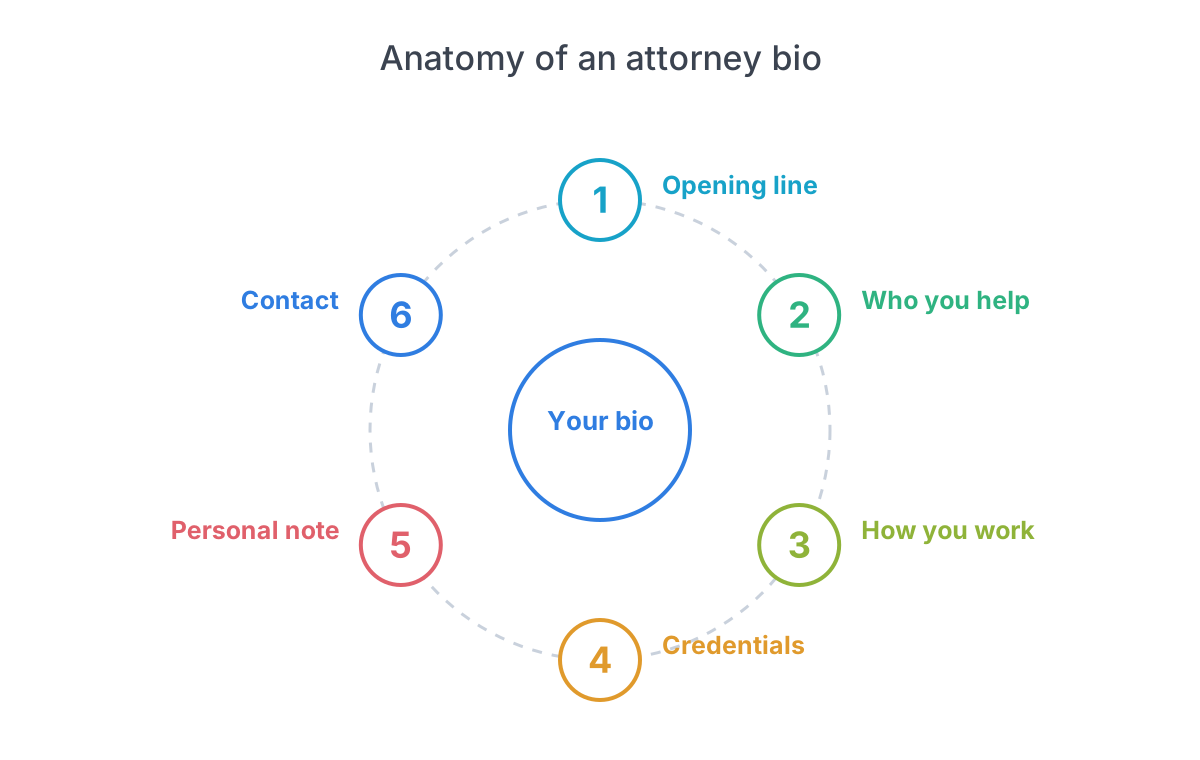
A bio that converts usually has these parts, in roughly this order:
- Opening line. Your name, what you do and who for, in one sentence.
- Who you help. The situations your clients are usually in, in their words, not yours.
- How you work. How you communicate, how fast you reply, what the first meeting looks like.
- Credentials. Admissions, education, certifications and memberships, as a scannable list.
- A personal note. One or two lines that make you a person: where you grew up, why this area of law.
- Contact. A phone number and a booking link right on the page, not just in the footer.
Notice what is missing: a paragraph that starts with law school. Your education matters, but it is proof, not the pitch. Put it in the credentials list where a reader who wants it can find it in a second.
How long should a lawyer bio be?
Long enough to answer the reader’s questions, short enough to scan on a phone. For most attorneys that means a short opening section the reader sees first, with credentials and detail below it.
There is no fixed rule. National Law Review’s tips on writing a lawyer biography put the ideal at 300 to 500 words, and suggest separate versions for your website, directories and speaker intros. A useful test: could a stressed reader understand who you help and how to reach you before they scroll? If not, the page is too long at the top, whatever its total length.
| Part | Rough length | Who reads it |
|---|---|---|
| Opening section | 2-4 sentences | Everyone |
| How you work | 1 short paragraph | Most visitors |
| Credentials list | 5-10 short lines | Checkers and referrers |
| Personal note | 1-2 sentences | People deciding |
Should a bio be first or third person?
Pick one voice for the whole firm and keep it consistent. Both are fine; mixing them across bios looks careless.
Third person (“Maria handles custody cases”) reads naturally on a firm site with several lawyers and is easier to reuse in directories and speaker intros. First person (“I handle custody cases”) feels warmer and suits solo practitioners whose site is really about one person.
I’d lean third person for multi-attorney firms, with a first-person quote or short note from the lawyer near the top. That gives you the consistency of third person and some of the warmth of first. Whatever you choose, use the full name once, then the first name after that. “Ms. Ortiz” in every sentence reads stiff.
A bio template, with a before and after
Rewrite the opening first: it does most of the work. Here is how our fictional Columbus firm might rewrite one partner’s bio. The attorney, Dana Ortiz, is made up.
Before:
Dana Ortiz received her J.D. from a state law school in 2009 and was admitted to the Ohio bar the same year. She is a member of several professional associations and has extensive experience in all areas of family law. Dana is a highly skilled, aggressive litigator dedicated to achieving the best possible results for her clients.
After:
Dana Ortiz helps parents in central Ohio work out custody, support and divorce, ideally without a court fight, and in court when there isn’t another way. She returns calls the same business day and explains every option in plain English before you decide anything.
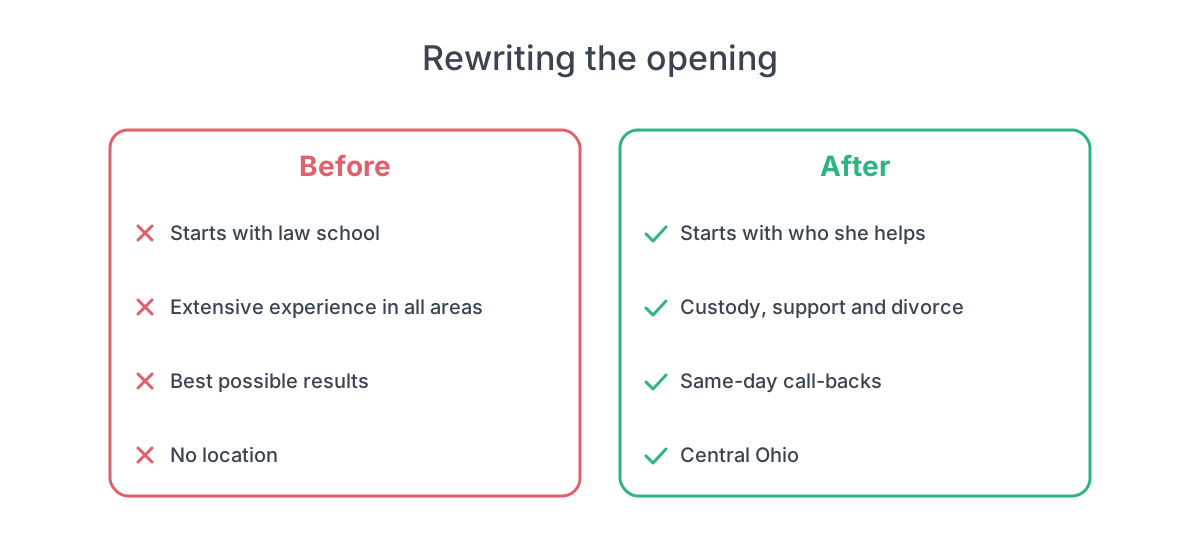
The rewrite cut three things: the law-school opener, the vague “extensive experience in all areas,” and the unprovable “best possible results.” It added who she helps, where, and one concrete promise about her own conduct (call-backs), which she can actually keep. The credentials didn’t disappear; they moved to the list below.
You can reuse that structure for every attorney:
- Sentence one: name, who you help, with what, where.
- Sentence two: one specific thing about how you work.
- Short paragraph: the situations you see most, in the client’s words.
- Credentials list: admissions, education, certifications (with the certifying body), memberships.
- Personal note: one or two honest lines.
- Call to action: phone, booking link, and what happens next.
Ethics: what claims should a bio avoid?
Anything false, anything that sets up expectations you can’t back, and any specialist claim without a named certification. Rules vary by state, so check your state bar’s advertising rules before you publish; this is general information, not legal advice.
The starting point is ABA Model Rule 7.1: a lawyer may not make a false or misleading communication about their services. The comment to Rule 7.1 adds that even true statements can mislead. Past results can create an unjustified expectation, and an unsubstantiated comparison with other lawyers can mislead if it sounds provable.
On “specialist,” ABA Model Rule 7.2(c) says a lawyer may not state or imply certification as a specialist unless they are certified by an organization approved by their state (or accredited by the ABA), and the communication clearly names that organization. In the Model Rules this now sits in Rule 7.2, but some states keep a separate specialization rule. California’s Rule 7.4, in the State Bar’s current Rules of Professional Conduct still restricts “certified specialist” claims, while letting lawyers say their practice is limited to or concentrated in a field. The same rule set’s comment to Rule 7.1 says promising the result of a particular case is misleading.
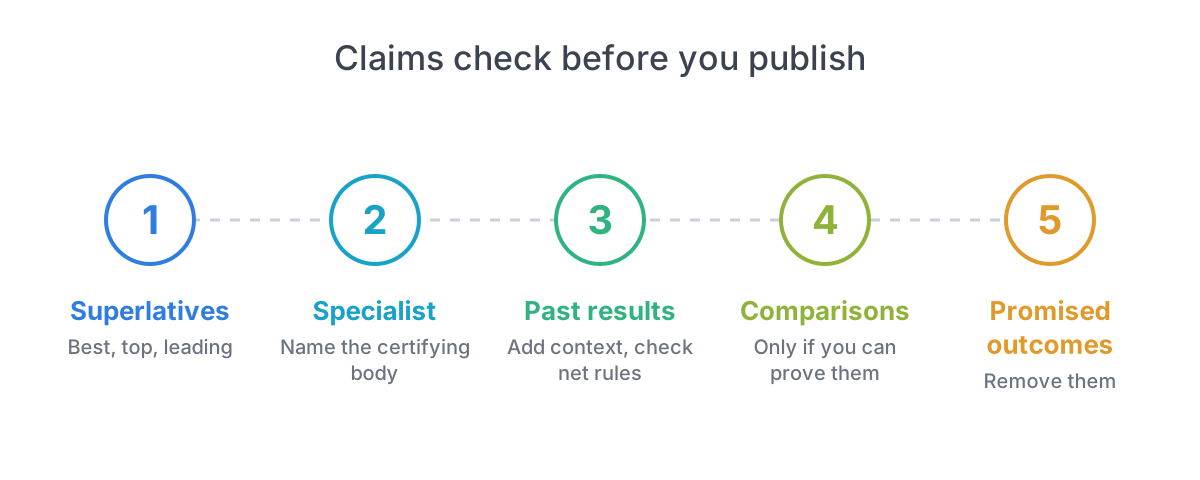
| Phrase | Risk | Safer version |
|---|---|---|
| “The best divorce lawyer” | Unprovable comparison | “Focuses on divorce and custody” |
| “Certified specialist” | Needs named certifier | Name the certifying body |
| “We win” | Implies a promised outcome | Describe how you prepare |
| “$2M recovered” | Unjustified expectation | Add context, check state rules |
Two more checks. The GPSolo article notes that some states don’t allow a settlement total without the client’s net amount, and that case examples can reveal confidential client information (ABA GPSolo). So treat case results and client stories on a bio with the same care as anywhere else on the site.
SEO and layout details
Make each bio its own page, with a clear title, a real photo and the attorney’s name in the right places. These are small jobs that help both search engines and readers.
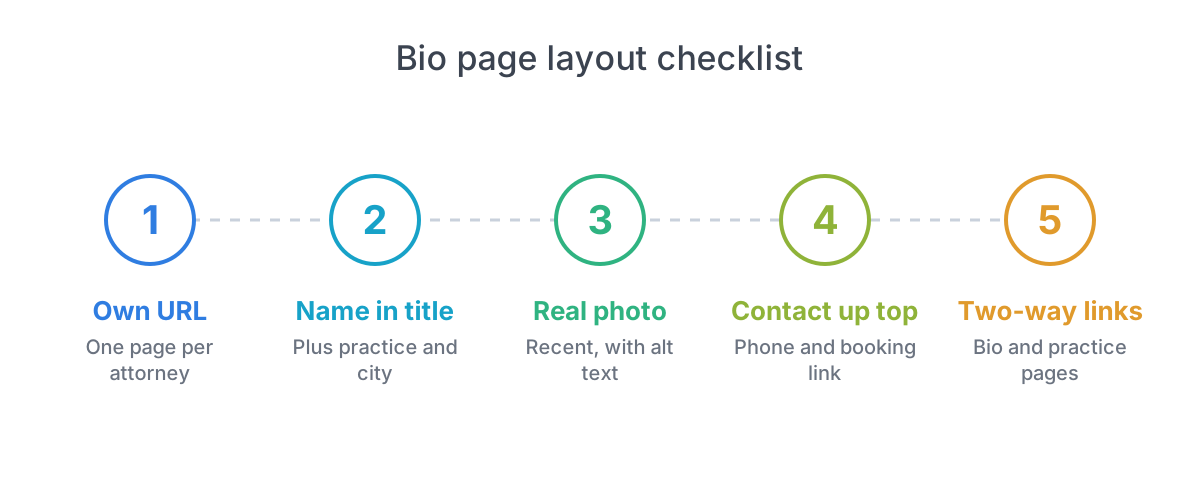
- One URL per attorney, such as
/attorneys/dana-ortiz/, not a single team page with everyone in tabs. - Name in the page title and heading, plus the main practice area and city: “Dana Ortiz, Columbus Family Law Attorney.”
- A recent, real photo with alt text that names the person. Readers notice a ten-year-old headshot when they meet you.
- Links both ways. Each bio links to the practice pages the attorney handles, and those pages link back to the bio.
- Structured data. Google’s documentation lists an employee page on a company website as a fit for ProfilePage markup, which needs at least the person’s name. Google also says markup alone won’t make a search feature appear.
If your bios sit inside a bigger redesign, our law firm website design guide covers how they fit with the rest of the site, and building trust with your website goes deeper on photos and proof.
How often should you update a bio?
Review every bio twice a year, and right away when something material changes. A stale bio quietly undercuts everything else on the page.
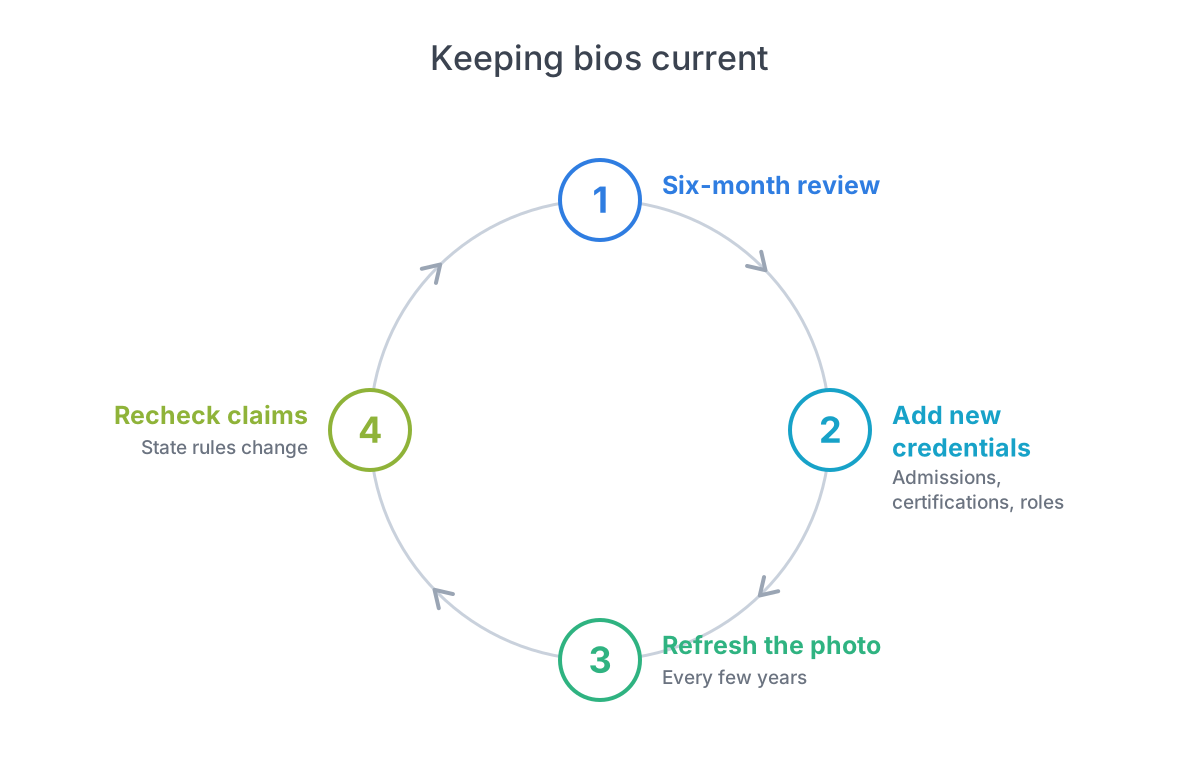
Put it on the calendar with your other housekeeping. Each review, check:
- New admissions, certifications or roles.
- Practice areas the attorney no longer handles.
- The photo, if it’s more than a few years old.
- Every claim against your state’s current rules, since they change.
When a lawyer leaves the firm, take the bio down or redirect it promptly. Comment 5 to ABA Model Rule 7.1 says a firm name or designation is misleading if it implies a connection with a lawyer not associated with the firm, and a live bio for someone who left sends the same signal. Your state’s rule may say more.
Where to start
Pick your most-visited bio and do three things this week:
- Rewrite the first two sentences so they say who you help, with what, where, and one thing about how you work.
- Run the claims check. Remove superlatives, add the certifying body to any specialist claim, and check case results against your state’s rules.
- Put a phone number and booking link in the opening section, not just the footer.
If you’d rather have someone handle the page structure, photos and markup for you, that’s part of our law firm website design work.